How to Handle 3x More Support Tickets Without Hiring a Single Agent
5 mins read
Every ecommerce brand hits the same wall at some point. Orders go up, tickets go up, and the instinctive response is to hire. Another agent. Then another. Then a team lead to manage them. Before long, customer support has become one of the biggest line items in the business and it's still not keeping up.
There's a better way. And the brands that have found it aren't working with bigger teams. They're working with smarter ones.
Why hiring more doesn't scale
Hiring feels like the obvious solution because it's the one that's always worked. More volume, more people. But it breaks down fast when you look at what those people are actually spending their time on.
The reality of ecommerce support is that the vast majority of conversations are completely predictable. Where is my order? Can I change my delivery address? How do I start a return? These questions come in every single day, in high volume, and they require the same answers every time. They don't need empathy or judgment. They just need a fast, accurate response.
When you hire to handle volume, you're hiring humans to do work that doesn't need humans. You're paying experienced people to copy-paste tracking numbers and send return labels. That's not just inefficient, it's demoralising for the team and expensive for the business.
The model that changes this is straightforward: let AI agents handle the predictable 70–80%, and let your human team focus on the 20–30% that actually needs them. Your team stays the same size while handling significantly more volume, at faster response times, across more channels, including hours they were never covering before.
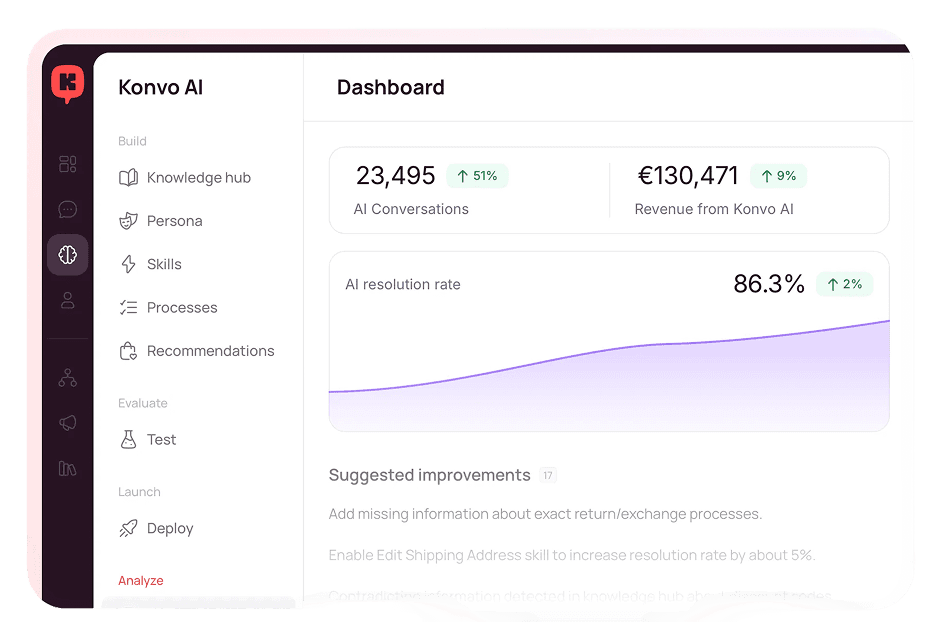
The AI + human division of work
This isn't about replacing your team. It's about routing work to whoever handles it best.
What AI agents handle well — 70–80% of volume:
Transactional queries: order status, tracking, delivery confirmations
Policy execution: returns within policy, standard refunds, address changes
Information requests: product specs, shipping options, availability
Account management: password resets, subscription changes, billing questions
These follow clear, predictable patterns. They need speed and accuracy, not judgment. AI agents are better at both than any human.
What your human team handles — 20–30% of volume:
Novel situations: problems the AI has never encountered, no precedent exists
Emotional complexity: a damaged gift for someone's anniversary, a delayed order that ruins a birthday
High-value relationships: VIP customers expecting personal attention, corporate accounts needing consultancy
Exception management: returns outside policy with a valid reason, special requests that don't fit the standard process
AI training: teaching the system, correcting errors, making it smarter over time
These need your personal judgment. Reading between the lines. Knowing when to break the rules. That's uniquely human.
The interesting shift is what happens to your team's skills under this model.
The old priorities — writing fast, memorising macros, managing inbox triage matter less. The new ones that drive career growth are different: teaching the AI system so one correction prevents 100 future errors, exercising judgment under ambiguity, building proactive customer relationships, spotting patterns before they become problems.
How to structure your hybrid team
Most brands implement an AI agent and then try to fit it into their existing org chart. That doesn't work. The roles were designed for all-human teams built around processing volume. When AI handles 70% of that volume, the structure needs to change too.
The new model organises around three functions, not ticket counts.
Resolution Delivery — ensuring problems get solved fast and correctly. These are your most autonomous agents, focused on the complex cases that reach them: situations without precedent, VIP relationships, high-risk orders.
System Intelligence — making the AI agent smarter over time. Reviewing frequent topics, identifying knowledge gaps, filling them with the right content. One good training session prevents hundreds of future tickets.
Experience Excellence — one person, usually the team lead, responsible for consistency between AI and human interactions, brand voice alignment, and early detection of systemic issues.
How this maps to team size:
Small teams (1–3 people): Everyone wears all three hats throughout the day. Mornings resolving the complex cases the AI escalated overnight. Midday training the AI on patterns spotted. Afternoons reviewing random AI conversations to catch anything off-brand. The job is no longer processing tickets, it's managing the system.
Larger teams (4+ people): Specialise by function. Around 70% of the team on Resolution, handling complex and VIP cases. Around 30% on System Intelligence, owning AI performance and capability expansion. One person on Experience Excellence, keeping the whole machine on-brand and consistent.
The hardest test: peak season
Black Friday used to mean panic-hiring temporary staff, 16-hour days, and a customer experience that suffered anyway. With an AI agent absorbing the routine volume, the same team that handles normal operations can manage a 10x spike, because the AI doesn't get tired, doesn't panic, and doesn't need overtime.
The goal shifts from surviving peak season to leading it. While most brands disappoint their customers during the busiest weeks of the year, the ones with AI-first ecommerce support show up consistently. Customers remember who was there when it mattered.
The shift that changes everything
Ecommerce support was built around human limitations, how many tickets can one person handle, how fast can they type, how do you scale. AI agents eliminate those limitations. Not by replacing humans, but by changing what the job actually is.
Your team stops processing tickets and starts managing a system. Obsessing over outcomes, not surviving volume. That's not doing the same work more efficiently. That's doing a completely different and better job.
Konvo is an AI Customer Platform built for ecommerce. Connect it to your shop system, WMS or 3PL and your AI agent resolves tickets, manages orders and handles complex processes across every channel, so your team can focus on what actually needs them.