AI Customer Service for eCommerce: What Actually Works in 2026
7 mins read
Something interesting is happening in ecommerce customer service right now. Brands that were hiring their way through support backlogs two years ago are now running leaner teams, responding faster, and covering hours they never could before, not because they found better agents, but because they stopped making agents do the work that AI can handle.
Customer service automation used to mean clunky chatbots and FAQ pages that frustrated everyone. Today it means something fundamentally different: AI agents that understand context, read intent, connect to your store's data in real time, and resolve conversations end to end, including the messy ones, like processing a refund or rerouting a delayed shipment.
No script. No menu. No wall.
This shift isn't coming. It's already here. And for ecommerce brands on Shopify, WooCommerce, or any major platform, the question isn't whether to automate, it's how to do it in a way that actually works.
The old model was built for a different era
For most of ecommerce history, customer support worked like this: hire agents, open a ticket inbox, try to keep response times under a day, and hope nothing blew up during Black Friday.
It was expensive, hard to scale, and deeply reactive. The only way to handle more volume was to hire more people, which meant support costs grew in direct proportion to revenue. Not exactly a sustainable model.
What made it worse was the nature of the tickets themselves. The vast majority of ecommerce support conversations aren't complex.
A customer wants to know where their order is.
Another wants to change a shipping address.
Someone needs to return an item.
These questions are predictable, repetitive, and time-sensitive, customers want answers fast, not in 8 hours when the morning shift arrives.
That's the structural problem AI agents solve. Not by replacing human judgment in difficult situations, but by removing humans from conversations that never needed them in the first place.
Why AI automation is changing
The AI agents available two years ago weren't up to the job. Rule-based chatbots could handle simple FAQ responses, but the moment a customer asked something slightly outside the script, the experience fell apart. You'd end up with frustrated customers and a support team still drowning in tickets.
What's changed is the underlying AI itself. Modern large language models can understand intent, not just keywords. They can read the full context of a conversation, infer what a customer actually needs, access live order data from your Shopifyor WooCommerce store, and take real actions, not just suggest them.
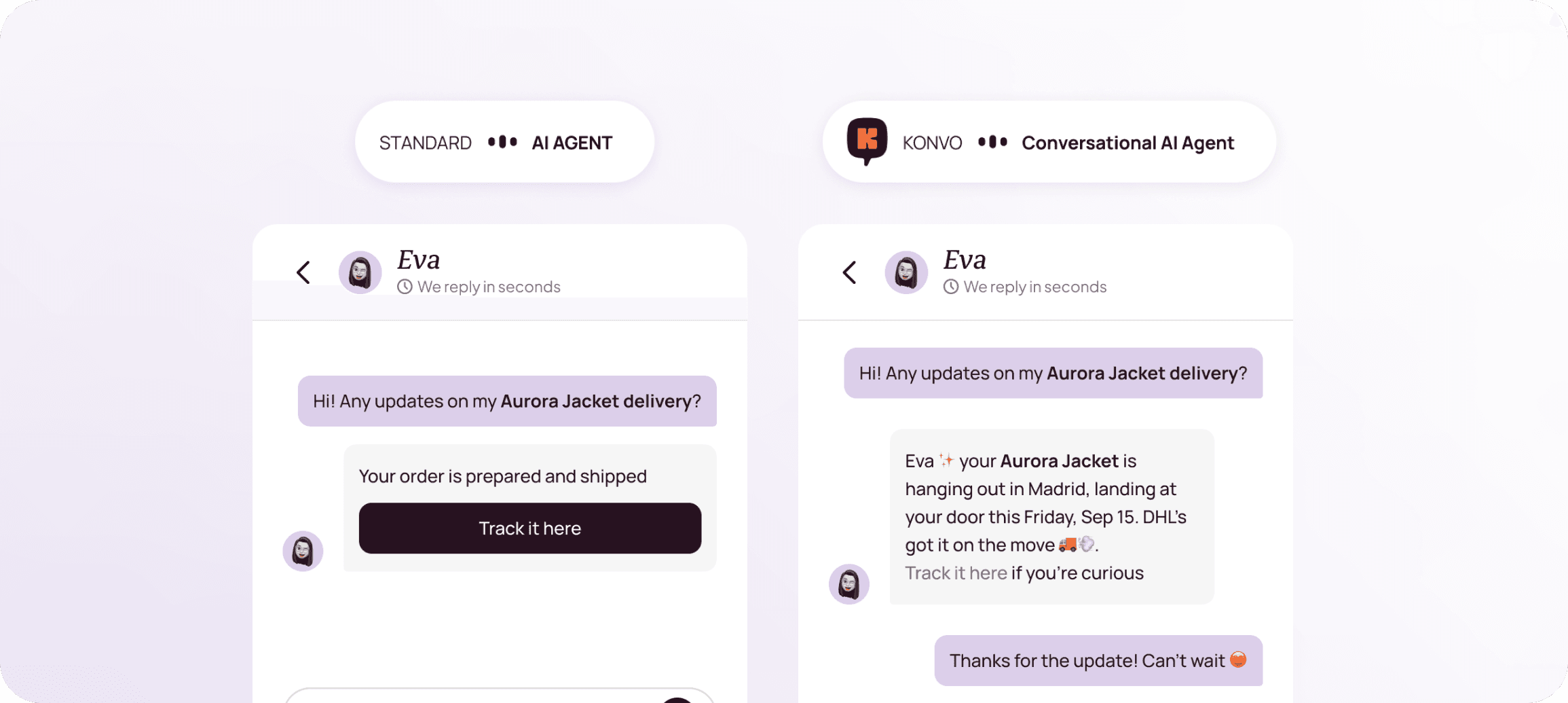
The difference between "I can see your order was shipped on the 12th, please contact us for more details" v.s "Your order is running two days late, I've flagged this with the carrier and here's a 10% discount for the inconvenience" is the difference between old automation and a real AI agent.
This is why brands that tried customer service automation in the past and gave up are revisiting it now. The ceiling has moved significantly , and it keeps moving.
Types of AI agents explained
Not every solution is solving the same problem, and it's worth understanding the landscape before making decisions.
At the most basic level, rule-based chatbots still exist and still have a place for very small stores handling simple, predictable queries. They're cheap to set up and better than nothing. But they hit their limits fast, and they can actively damage customer experience when queries get even slightly complex. There's no real intelligence behind them, just logic trees.
Helpdesks with AI features represent a middle ground that many established brands use today. These platforms manage your ticket inbox across channels — email, chat, social — and use AI to help agents work faster: suggesting responses, tagging tickets, summarising conversation history, flagging priorities. The human is still at the center of every conversation, with AI as a supporting layer.
AI customer platforms are the newest category, and the one seeing the most growth. Here, the AI agent handles conversations autonomously from start to finish; understanding natural language, accessing order data, processing actions, and escalating to a human only when the situation genuinely requires judgment. This is the model Konvo is built around: an AI Customer Platform that connects natively to Shopify and WooCommerce, resolves tickets end to end, and only loops in a human when it truly matters. Automation rates in this category typically reach 70–80% of total ticket volume, which changes the economics of ecommerce support entirely.
The right choice depends on your volume, your team size, and how much of the routine work you want your AI agent to carry independently.
What this looks like in practice
The stores getting the most out of AI agents share a few things in common. They're not using them as a cost-cutting measure that degrades the customer experience, they're using them to do things they simply couldn't do before.
The clearest example is after-hours coverage. A customer browsing at 11pm used to face a wall of silence until the next business day. With an AI agent handling the conversation, they get a real response in minutes. If they want to know where their order is, the AI pulls the live data and tells them. If they want to change something before it ships, it gets changed automatically, without a human in the loop.
A good example of what that unlocks is Cafe San Jorge. Before automating, conversations that came in after 6pm just waited. After deploying Konvo's AI agent, those conversations got handled immediately and that after-hours coverage opened up a stream of revenue that simply wouldn't have existed otherwise.
Another common use case is peak season. The brands that dread Black Friday because of the support spike are the ones still running manual operations. The brands that have handed the routine work to an AI agent can absorb several times their normal traffic without adding headcount and without quality dropping.
"Black Friday was crazy. Without AI handling support, I would have lost my mind, it would have been literally impossible."
— Jordi Ripolles , CEO and Co-founder at Synsera Labs
The interesting side effect, and the one that often surprises brands when they first see it, is what happens to the human agents. When the AI is handling the repetitive work, agents are freed to do what humans actually do well: handle complex complaints with empathy, manage escalations thoughtfully, proactively reach out to customers with unresolved issues. Job satisfaction tends to go up alongside efficiency.
What makes a great AI agent
Whatever shop system, CRM or 3PL your store runs on, here's what the best AI agents for ecommerce have in common:
Deep ecommerce integration. An AI agent that can't access your order data in real time can only deflect, not resolve. Look for native connections to your store so the AI can look up orders, process refunds, update shipping details, and manage returns without a human in the loop.
Smart escalation. The best AI agents don't try to automate everything. When a conversation needs a human — a genuinely upset customer, a complex claim, a sensitive situation — the AI should hand it off with full context, so the agent never has to ask the customer to repeat themselves.
Multichannel consistency. Email, live chat, WhatsApp, Instagram DMs , wherever your customers reach out, the experience should be the same. An AI agent that works on one channel but not others creates trust gaps.
Fast, brand-specific learning. Generic AI isn't enough. The agent needs to understand your products, your policies, and your tone, not read from a generic manual. The best AI customer platforms ingest your documentation, past conversations, and internal processes so the AI responds like someone who actually knows your brand.
The direction this is heading
The trend line is clear. Ecommerce brands that treat customer service as a pure cost centre are going to fall further behind. The ones investing in AI agents aren't just cutting costs, they're building a capability that compounds over time: faster responses, broader coverage, richer data on what customers actually need, and a support team that's finally doing work worth their time.
The trend line is clear. Ecommerce brands that treat customer service as a pure cost centre are going to fall further behind. The ones investing in AI agents aren't just cutting costs — they're building a capability that compounds over time: faster responses, broader coverage, richer data on what customers actually need, and a support team that's finally doing work worth their time.
What's emerging is a model where AI handles the volume and humans handle the nuance. Not AI replacing support teams, but AI customer platforms making those teams dramatically more effective — and freeing them to focus on the conversations that actually benefit from human judgment.
For ecommerce brands, whatever shop system, CRM or 3PL they run on, the AI agents to do this well exist right now. The gap between brands that have made this shift and those that haven't will keep widening.
AI customer service automation isn't a future investment, it's the operational decision separating the ecommerce brands growing efficiently today from those still hiring their way through every peak. Konvo is the AI Customer Platform built to make that shift as fast and seamless as possible.